

https://www.pexels.com/photo/modern-home-office-setup-with-stylish-decor-30836165/
The dream of the commute-less life has, for many of us, turned into the reality of working from a kitchen island while a toddler uses our legs as a jungle gym and the dishwasher runs a chaotic rhythm in the background. If you have reached the limit of your patience with makeshift workspaces, you have probably looked toward that underutilized, oil-stained cavern attached to your house: the garage.
Converting a garage into a home office is one of the more practical ways to add square footage and professional boundaries without the cost of a full-scale home extension. However, it is not as simple as throwing down a rug and plugging in a laptop. To turn a cold, echoing box into a productive workspace, there are several critical factors to navigate.

Photo by Faizur Rehman: https://www.pexels.com/photo/modern-home-office-setup-with-computer-and-headphones-28754729/
1. The Legal Groundwork: Permits and Zoning
Before you pick up a sledgehammer or even a paintbrush, talk to your local building department. This is the step everyone wants to skip, but ignoring it can create serious problems when you eventually sell your home.
In many jurisdictions, converting a garage is considered a change of use for the space. You will likely need building permits for electrical work, structural changes, and potentially plumbing.
Zoning laws are worth checking too, as some HOAs and municipalities require a minimum number of covered parking spaces, meaning eliminating your garage could put you in violation of local codes. Increasing the finished square footage of your home may also trigger a reassessment of your property taxes.
Always get your permits in writing. It ensures the work is up to code and protects your home’s resale value down the line.
2. The Challenge of Climate Control
Most garages are built to keep a car dry, not to keep a human comfortable for eight hours a day. Without a solid plan for heating, ventilation, and cooling, your new office will be an oven in summer and a meat locker in winter.
Insulation is not optional. You will need to insulate the walls, the ceiling, and the garage door if you plan to keep it. Traditional fiberglass batts or spray foam are the reliable choices here. Do not overlook the floor either; a concrete slab pulls heat right out of the room and anyone standing on it.
For climate control itself, mini-split systems are the most popular choice for garage conversions. They handle both heating and cooling, run efficiently, and do not require extending your home’s existing ductwork.
Tapping into your home’s central air is possible, but often requires a larger blower motor and can be expensive to route properly. Space heaters and window AC units are tempting shortcuts, but they are loud, inefficient, and costly to run long-term.
3. Electrical and Connectivity
A standard garage might have one or two outlets designed for a chest freezer or a power tool. A modern office needs considerably more. You will likely need to run a new sub-panel or at least several new circuits to support dual monitors, a desktop, a printer, a coffee station, and proper lighting. Underestimating your electrical needs is the fastest way to find yourself tripping breakers in the middle of a video call. Aim for more outlets than you think you need.
Your home Wi-Fi signal probably struggles to penetrate the firewall between your house and the garage. For remote work, a weak connection is not workable. If the walls are open during construction, run a Cat6 ethernet cable from your router directly to the garage. It is the only way to guarantee consistent, stable connectivity. A high-end mesh Wi-Fi node can work as an alternative, but a physical cable is always the more reliable option.

Photo by Alpha En: https://www.pexels.com/photo/modern-home-office-with-computer-and-plants-28461050/
4. Lighting: Beyond the Fluorescent Hum
Garages are famously dim. To create a space that does not feel like a basement, you need a layered approach. Recessed LED cans or stylish flush mounts handle overall illumination. Adjustable desk lamps with a high Color Rendering Index take care of focused task lighting. Natural light, though, is the biggest factor for both mood and productivity.
If your garage has no windows, consider adding one during the conversion, or replace the garage door with a glass-paneled version. A skylight or solar tube can also bring in daylight without sacrificing wall space. It is an investment that pays back in energy and focus every single workday.
5. Flooring: More Than Just Paint
Concrete is hard on the joints and harder on the eyes. Since you are working with a slab that may be slightly sloped toward the door, your main options are epoxy coating, which is durable and easy to clean but offers no insulation; luxury vinyl plank, which is waterproof and can be installed over a subfloor; or carpet tiles, which are excellent for acoustics and warmth, provided the concrete is sealed first to prevent moisture from wicking into the fabric.
If you have the ceiling height, consider building a sleeper floor, a raised wooden frame with insulation inside. It makes the room feel exactly like the rest of the house and solves the cold slab problem entirely.
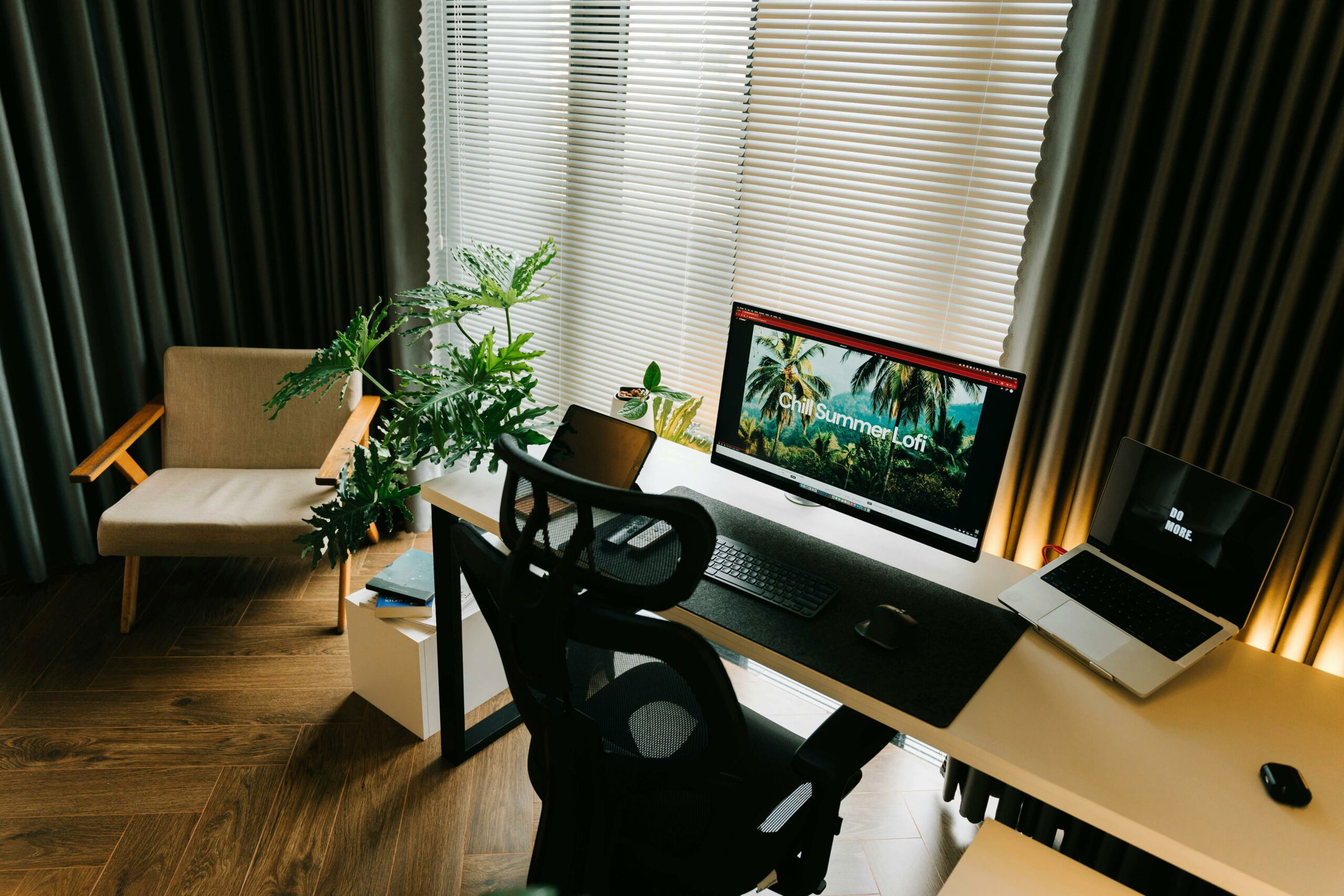
Photo by Alpha En: https://www.pexels.com/photo/minimalist-home-office-with-modern-decor-31726564/
6. Your Garage Door
This is the biggest aesthetic and functional choice you will make. Keeping the existing door works for temporary or reversible conversions, but it is a reliable source of drafts and noise.
Replacing it with a modern glass garage door looks striking and brings in excellent light, though the insulation value is poor. Walling it in entirely, removing the door and building a permanent wall with windows, makes the space feel like a true room. It is the most expensive and permanent option, but it is also the most effective.
7. Acoustics: Controlling the Echo
Garages are full of hard, reflective surfaces. Without some acoustic treatment, your voice will echo noticeably during calls. Area rugs, curtains, and upholstered furniture absorb a lot of that bounce.
Fabric-wrapped acoustic panels on the walls go further and look intentional rather than improvised. Getting the acoustics right is one of the details that separates a converted garage from a proper office
8. Budget and Return on Investment
The cost of a basic garage-to-office conversion depends on the level of finish and your HVAC needs. You may not recoup the full cost in immediate home value, since you are trading a garage for an office, but in a market where buyers increasingly expect dedicated remote workspaces, a well-executed conversion is a genuine selling point.
The lifestyle return for anyone working from home full-time is harder to put a number on, but it is real.
Make the Right Move
Converting your garage into a home office is more than a renovation. It is a practical investment in your focus, your professional image, and your daily quality of life. By working through the fundamentals, permits, climate control, and connectivity, you can turn a dusty storage space into a workspace that actually works.
When you are ready to stop working from the couch, you do not have to figure it out alone. Professional help ensures the job is done properly from the start.
Contact Renotight at info@renotight.com or reach out through our online site form, and let’s create the perfect home office for your needs today.

Get Inspired: Check out our Remodel Services.